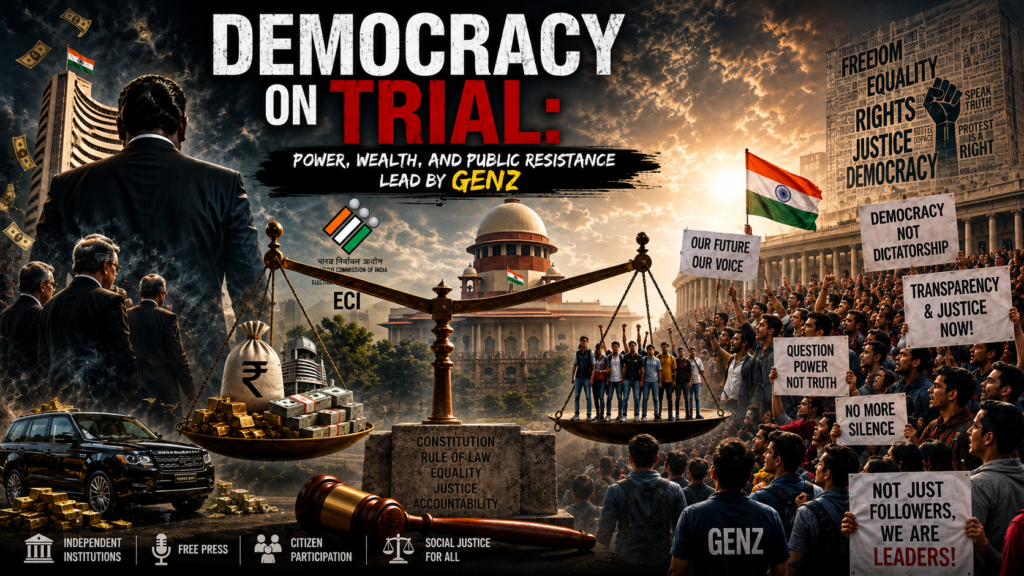
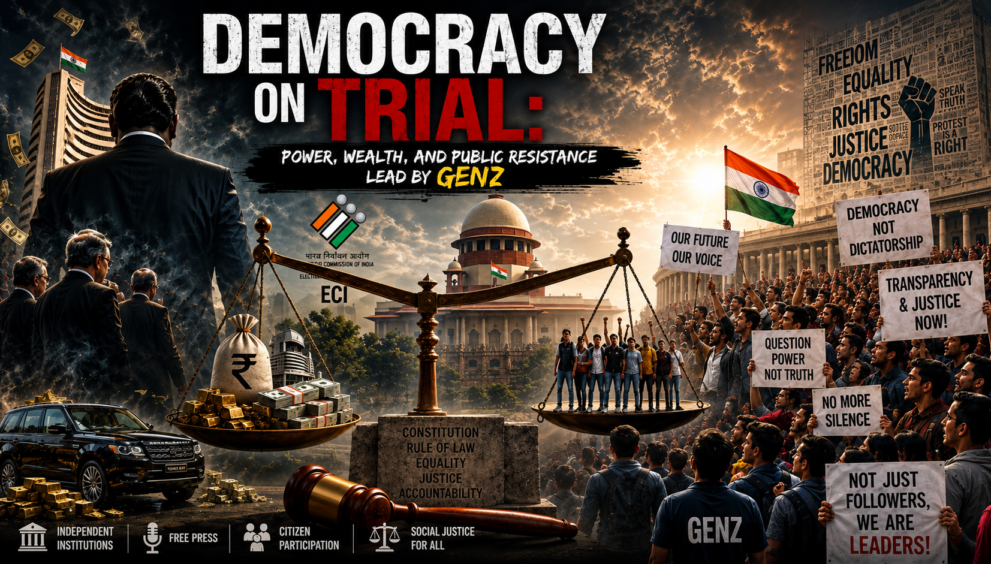
Democracy on Trial: Power, Wealth, and Public Resistance lead by GenZ

After the West Bengal elections, Indian electoral democracy appears to have entered a phase of political vacuum, particularly in states such as West Bengal, Bihar, Maharashtra, and Orissa. A healthy electoral democracy thrives on genuine competition among political parties.
It is through such competition that democratic institutions remain accountable and governments strive to serve the people, by the people, and for the people. However, contemporary Indian politics is becoming increasingly unpredictable, with competitive political forces seemingly weakened. This trend, it is argued, stems from the modus operandi of the current dispensation, allegedly aided by the Election Commission of India, particularly under the chairmanship of Gyanesh Kumar If such a trajectory continues, it could raise serious concerns about the vitality of electoral competition and the long-term health of India’s democratic institutions.
The recent ugly developments after the West Bengal elections created orchestrated and manipulated horse trading by the BJP government in the center and its counterpart in the states to facilitate the two-thirds majority in the parliament to achieve the nefarious goal of having eight hundred plus seats so that the BJP and RSS can rule India for many more terms! It is also possible that current dispensation can destroy the very basic features of the Constitution of India and ultimate manifestation in the form of so-called “Hindu Rashtra”!
What a weird circumstance created by the state with the coniavence of religion and cronycapitalist to be in the power for a long, long period. This nexus of BJP-RSS and many corporate houses has made India’s socio-economic and political establishment and fabric fragile. The gap between rich and poor has become wider, which was never before in the history of modern India.
The wealth and income gap in India is stark. The top 1% of the population holds about 40% of the country’s total wealth and captures over 22% of national income, making it one of the most unequal concentrations in the world. Conversely, the bottom 50% holds just 3% of national wealth.The gap between the rich and poor is measured across a few distinct areas:
Income Distribution: The top 10% of earners capture nearly 60% of the national income, while the bottom 50% of earners receive only 15%.
Wealth Disparity: While India has seen a massive surge in millionaires and billionaires, the bottom half of the population (roughly 670–700 million individuals) struggles with minimal wealth accumulation.
Consumption Expenditure:
According to the Household Consumption Expenditure Survey, the average monthly per capita expenditure in urban areas (Rs. 6,459) is nearly double that of rural areas (Rs. 3,773), highlighting a deep rural-urban divide.
Gender Pay Gap:
Female workers face severe disparities, earning just 63 paise for every 1 rupee earned by male workers, with women’s labor force participation remaining exceptionally low. Sources attribute this widening divide to unequal access to quality education, regressive tax structures, and unequal opportunities in the technology and formal economic sectors.
There may be a socio-economic holocaust that can destroy the very basic ideas of India. India may become a part of neo imperialism and colonial state rule by its own dirty nexus of BJP-RSS and their cronycapitalist friend.
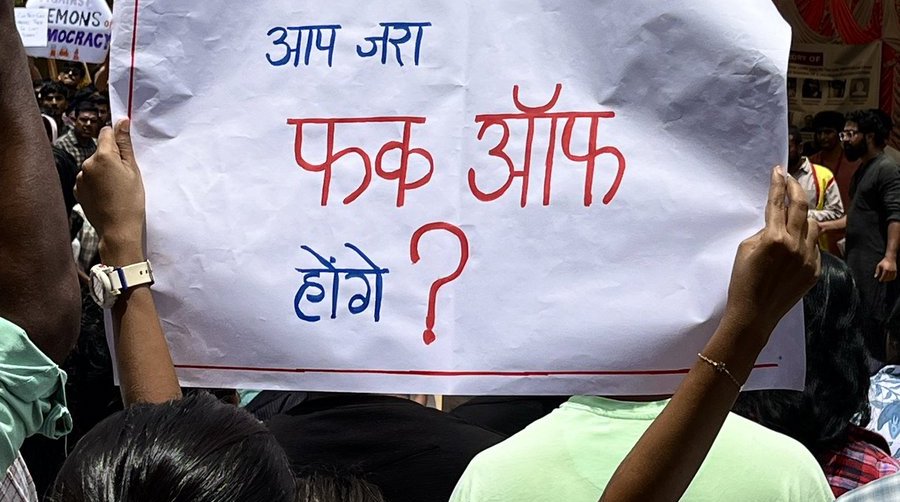
But recent developments of youth anger manifested in the form of agitation at Jantar-Mantar in Delhi and ultimately across the country has sent a message to the ruling regime that any mischievous daring autocratic action will be met with fierce consequences of democratic citizens, of course the gen-z, youth of modern India.